
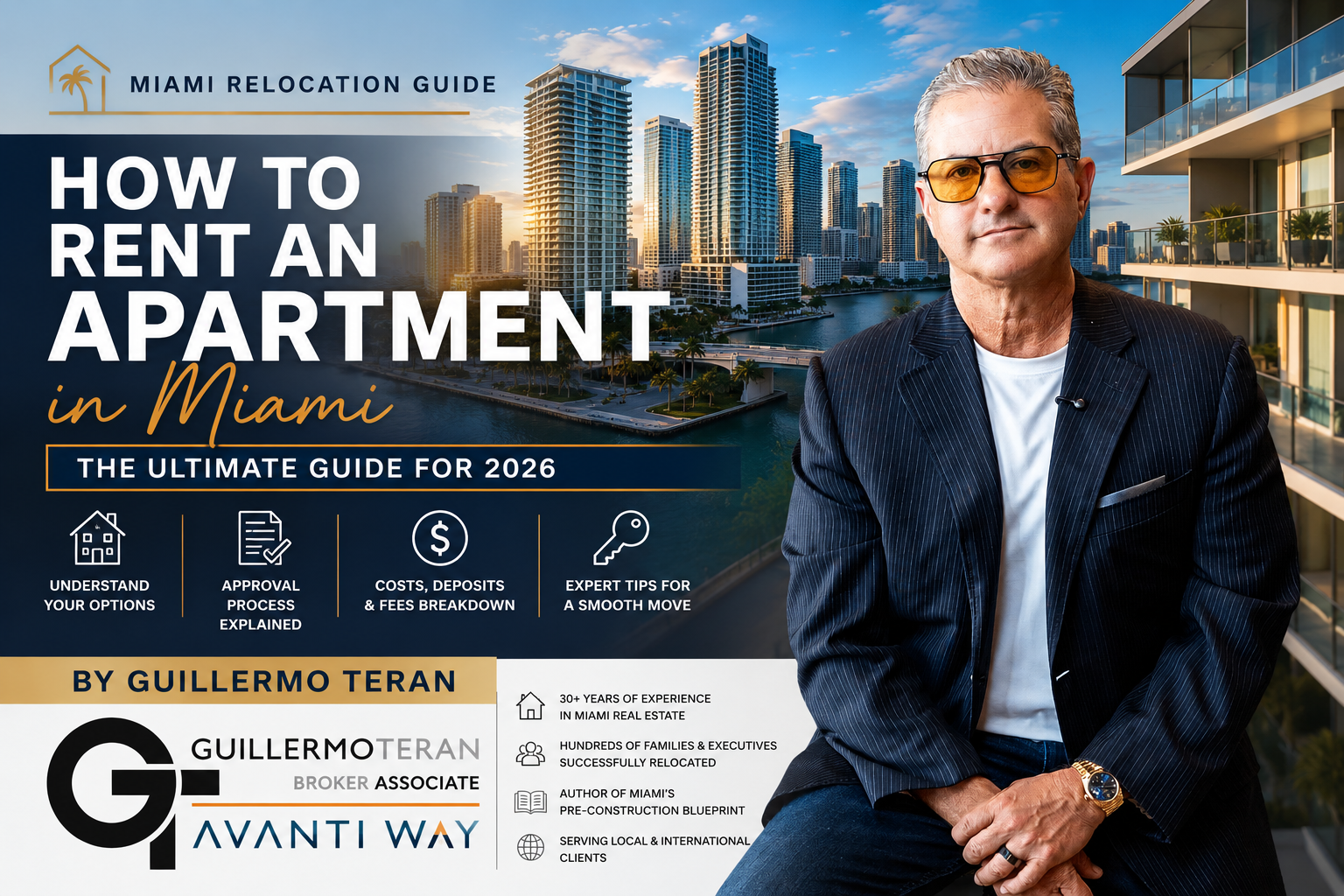
How to Rent an Apartment in Miami: The Ultimate Miami Relocation Guide
By Guillermo Teran
Broker Associate | Miami Relocation Specialist | Founder of the Avanti Way Pre-Construction Community | Author of Miami’s Pre-Construction Blueprint
Planning to Move to Miami? Start Here.
Whether you are relocating for work, lifestyle, investment, or family, renting is often the first step before buying a home in Miami.
But many people moving to South Florida quickly discover something important: renting in Miami works differently than in many other cities.
Miami has two main rental paths:
Renting from an individual property owner
Renting from a professionally managed apartment community
Understanding the difference can help you avoid surprises, prepare your documents, budget properly, and move with confidence.
Option 1: Renting from an Individual Property Owner
This is common in neighborhoods like Brickell, Downtown Miami, Edgewater, Midtown, Wynwood, Miami Beach, Coconut Grove, Coral Gables, Doral, and Aventura.
In this scenario, the condominium, townhouse, or home is owned by an individual landlord.
Many private landlords commonly request:
First month’s rent
Last month’s rent
One month security deposit
For a $3,500 rental, that means you may need about $10,500 upfront, plus building or application fees.
Association Approval
In many Miami condominium buildings, getting approved by the landlord is only the first step.
The condominium association may also require approval.
They may ask for:
Government-issued ID
Credit report
Background check
Proof of income
Bank statements
Employment verification
Previous landlord references
Application forms
Approval can take a few days or several weeks, depending on the building.
Option 2: Renting from an Apartment Community
The second option is renting from a professionally managed rental community.
These are apartment buildings or communities operated by management companies instead of individual owners.
The process is usually faster and more standardized.
They may require:
Online application
Credit check
Background check
Income verification
Employment verification
Approvals are often completed within one to three business days.
Move-In Costs: Private Landlord vs. Apartment Community
Rental Type
Typical Upfront Cost
Approval Process
Monthly Rent
Individual landlord
Often first, last, and security
Landlord + association approval
Often lower
Apartment community
Often first month + deposit or fees
Management company approval
Often higher
Example: $3,500 Monthly Rent
Rental Option
Estimated Upfront Cost
Individual landlord
About $10,500 plus fees
Apartment community
Often lower upfront, varies by property
Why Apartment Communities May Cost More
Apartment communities are often more expensive monthly because they may include:
On-site management
Maintenance team
Fitness center
Pool
Coworking areas
Package lockers
Concierge services
Resident amenities
You are paying for convenience, speed, and services.
Documents to Prepare Before Renting in Miami
Before starting your search, prepare:
Driver’s license or passport
Recent pay stubs
Employment verification letter
Bank statements
Tax returns if self-employed
Credit information
Previous landlord references
Pet records if applicable
Emergency contact information
International renters may need additional documentation or a larger deposit.
Understanding Lease Terms in Miami
Most residential leases in Miami are for 12 months.
Shorter leases may be available, but they usually cost more per month.
Before signing, ask about:
Renewal options
Early termination fees
Pet rules
Parking
Utilities
Renter’s insurance
Move-in fees
Association approval
Minimum lease period
Frequently Asked Questions
Is three months’ rent required by law in Miami?
No. It is not a legal requirement. It is a common market practice among many private landlords.
Can I rent in Miami without U.S. credit?
Yes, but you may need additional documents, proof of income, bank statements, or a larger deposit.
Do I need a real estate agent to rent in Miami?
It is highly recommended, especially if you are relocating. A local real estate advisor can help you understand neighborhoods, rental requirements, association rules, and move-in costs.
Are apartment communities easier to rent from?
Usually, yes. The process is often faster because there is no condominium association approval.
Which option is better?
It depends on your situation. If you want lower monthly rent and more condo inventory, a private landlord may be better. If you want speed, convenience, and lower upfront cost, an apartment community may be better.
Final Advice for Anyone Moving to Miami
Start your search 30 to 60 days before your move.
Have your documents ready.
Ask for all fees upfront.
Confirm association approval requirements.
Understand your lease terms before signing.
Miami is an incredible place to live, but the rental process can be very different from what newcomers expect. The more prepared you are, the smoother your relocation will be.
About Guillermo Teran
Guillermo Teran has been serving the South Florida real estate market since 1993. As a Broker Associate, relocation advisor, and founder of the Avanti Way Pre-Construction Community, he helps families, executives, investors, and international clients relocate to Miami with confidence.
He specializes in Miami relocation, luxury condominiums, pre-construction developments, investment properties, and helping clients understand the unique dynamics of the South Florida real estate market.
Guillermo is also the author of Miami’s Pre-Construction Blueprint, an educational guide designed to help buyers navigate today’s Miami condominium market.
If you are planning to move to Miami and need guidance renting, buying, or understanding the market, I would be honored to help you make a smart and confident decision.