What St. Regis Residences Miami Can Teach Us About How Real Estate Wealth Is Really Created
When most people look at a luxury development like St. Regis Residences Miami, they see the finished product.
They see the waterfront location, the architecture, the amenities, the St. Regis name and multi-million-dollar residences.
But that is not where the real story begins.
To understand how sophisticated real estate developers think, we need to look years before construction starts—at the land, the basis, the entitlement process, the partnership structure and the financing.
Because in development, some of the most important money is made long before the first residence is delivered.
St. Regis Residences Miami offers a fascinating case study.
Step 1: Land Control — Where the Real Story Begins
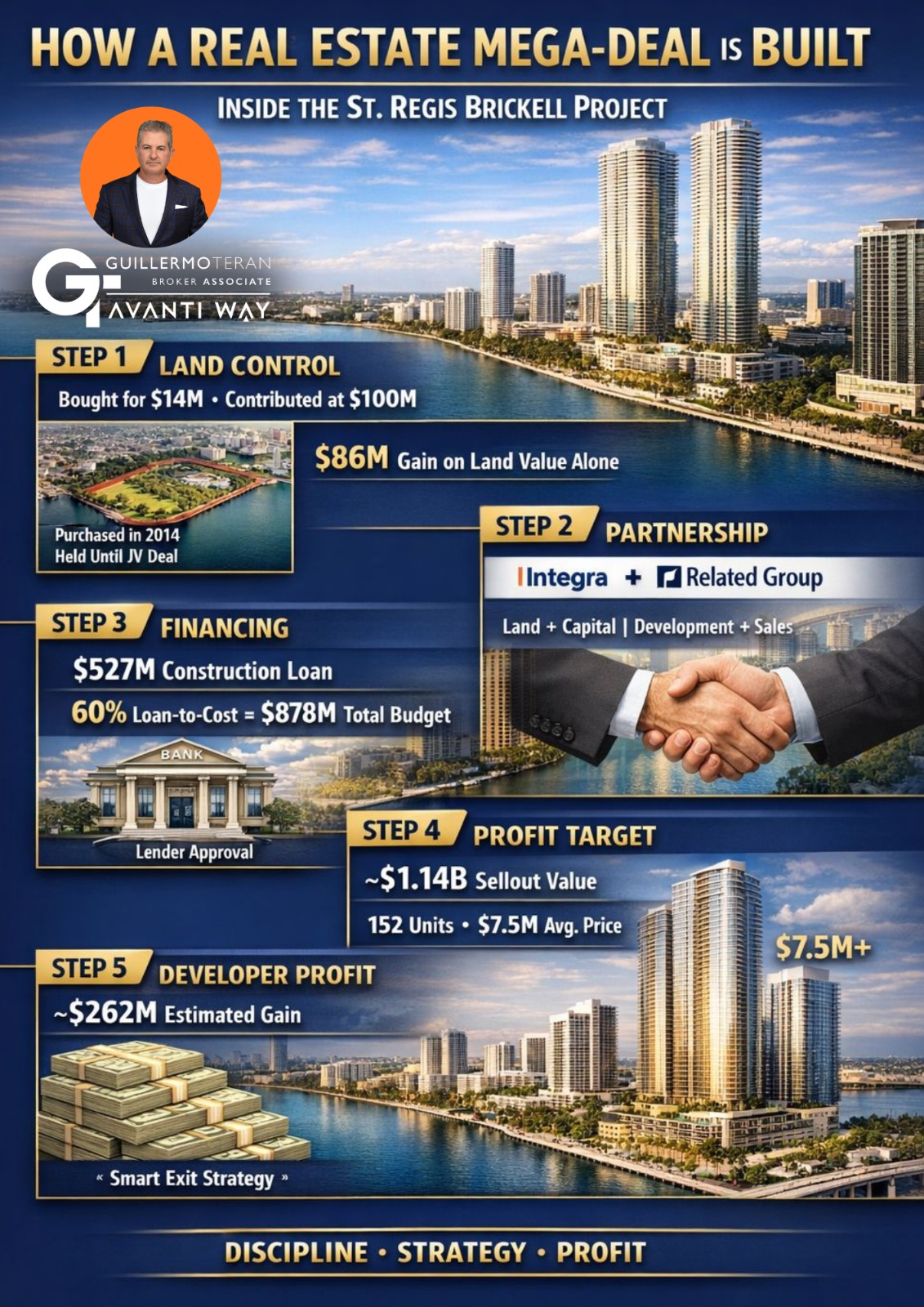
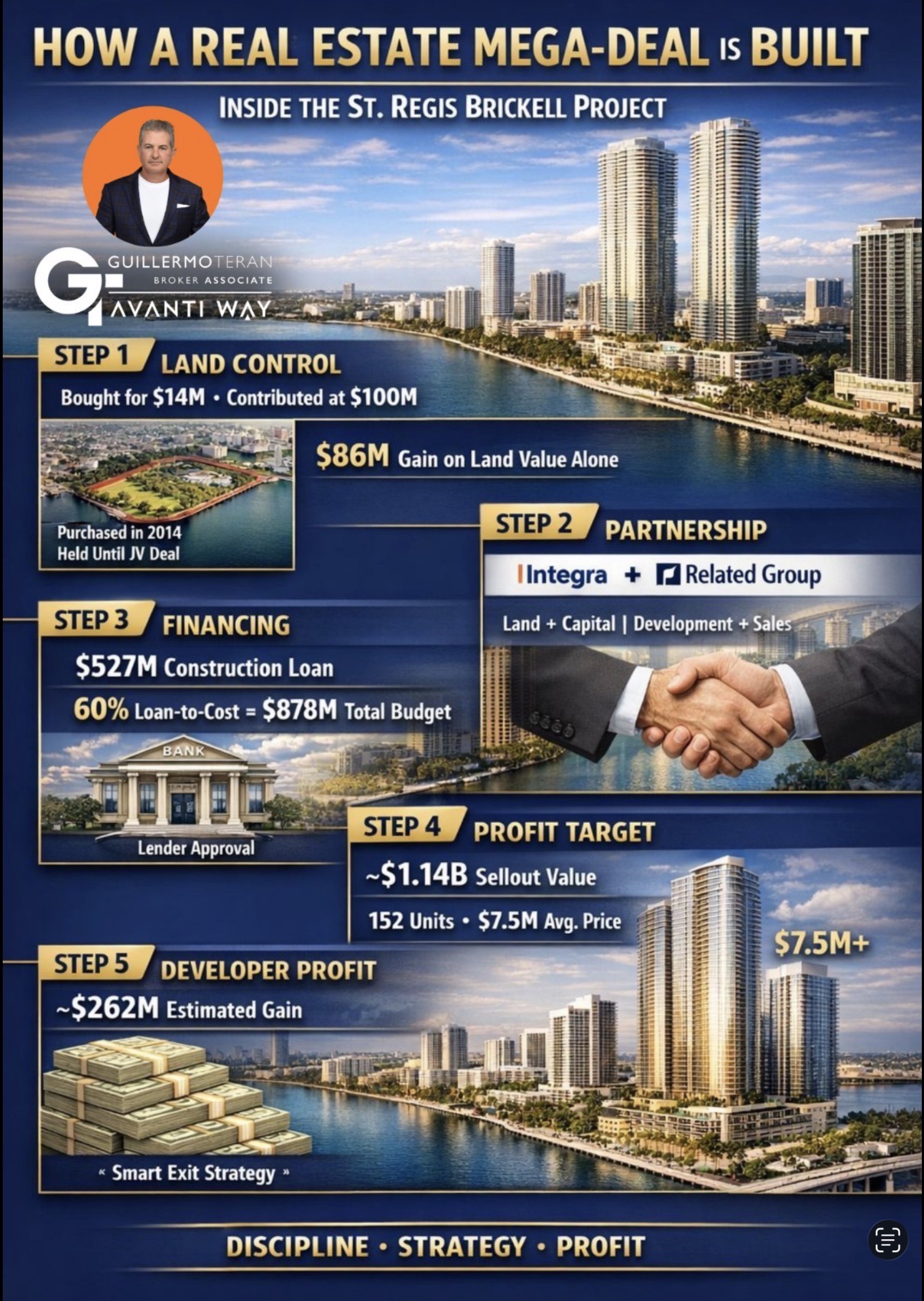
Integra Investments acquired the approximately three-acre waterfront property at 1809 Brickell Avenue in 2014 for approximately $14 million.
A decade later, an Integra affiliate sold the property to the Related Group and Integra joint venture for $100 million as the St. Regis development moved forward. (Commercial Observer)
Think about the economics.
Original acquisition: approximately $14 million
Later transaction value: $100 million
That represents roughly $86 million of additional land value over the period.
And this happened before buyers moved into a single condominium.
How?
Through one of the oldest strategies in real estate:
Buy the right land. Control it. Improve its development potential. Be patient.
The land itself is only part of the equation. Zoning, density, entitlements, approvals, market timing and what can ultimately be built on a property can dramatically alter its economic value.
This is why sophisticated developers obsess over their land basis.
A great development usually begins with a great piece of land acquired at the right price.
Step 2: Entitlement Creates Value Before Construction
Many people believe developers create value only when they construct a building.
That is not necessarily true.
Development value can begin being created years earlier.
A developer can acquire a parcel, work through zoning and approvals, determine the highest and best use, reposition the property and wait for the market around it to mature.
The physical land may not change.
But its economic potential can change dramatically.
That distinction is critical.
Someone looking at a property in 2014 may simply see three acres of waterfront land.
A sophisticated developer may see what that land could become ten years later.
That is development thinking.
Step 3: Partnership — Stack Different Strengths
Projects approaching a billion dollars in total value are rarely built through one skill set alone.
The St. Regis Residences partnership combines Integra Investments and Related Group.
Each side brings different strengths.
Integra brings its history with the property, investment expertise and development capabilities.
Related brings decades of condominium development experience, execution capabilities, marketing power, buyer relationships and an established luxury-development platform.
This is another lesson investors should understand:
Scale comes from combining strengths.
The best joint ventures are not simply two companies putting money into the same project.
They are combinations of capabilities.
Land.
Capital.
Development expertise.
Construction execution.
Marketing.
Sales.
Branding.
When those pieces fit together, very large projects become possible.
Step 4: Financing — Follow the Capital
In September 2024, Related Group and Integra secured approximately $527 million in construction financing from TYKO Capital for St. Regis Residences Miami.
At that time, more than 60% of the project’s 152 residences were reportedly already under contract. (Commercial Observer)
That is a major financing commitment.
But there is an important lesson here.
A construction lender does not simply look at a rendering and decide to lend hundreds of millions of dollars.
The lender analyzes the project.
The capital stack.
Construction costs.
Sponsor experience.
Presales.
Buyer deposits.
Pricing.
Market demand.
Collateral.
Potential downside.
And the ability of the development to ultimately repay the loan.
That does not mean a large loan guarantees that a development will succeed.
Every project still carries risk.
But obtaining substantial construction financing is an important milestone because sophisticated capital has independently examined the development economics.
Step 5: Understanding the Underwriting
This is where the numbers become interesting.
We know the construction financing was approximately:
$527 million
Suppose, purely for educational purposes, that a project of this type were financed at approximately 60% loan-to-cost.
The calculation would look like this:
$527M ÷ 60% = approximately $878M in implied total project cost
Again, this is an underwriting illustration—not a disclosure of the developer’s actual cost basis.
Now assume a developer targeted approximately a 30% margin on cost.
The math would look like this:
$878M × 1.30 = approximately $1.14 billion
Interestingly, contemporaneous reports placed the actual projected sellout for St. Regis Residences Miami at approximately $1 billion. (Commercial Observer)
With only 152 residences, we are dealing with an extraordinarily high-value product.
That pricing becomes easier to understand when you examine what is being sold:
Prime Biscayne Bay waterfront.
South Brickell.
Limited inventory.
Large residences.
Robert A.M. Stern Architects.
Rockwell Group interiors.
Extensive amenities.
And one of the most globally recognized names in luxury hospitality: St. Regis.
This is not simply a condominium tower.
It is a highly engineered luxury real estate product.
Step 6: Why the Development Economics Work
Put the pieces together.
The developer began with an unusually strong land position.
The property was controlled years before construction.
The value of that site increased substantially.
A major development partnership was created.
The project obtained substantial presales.
A globally recognized luxury brand was attached.
More than half a billion dollars in construction financing was secured.
And a limited number of very high-value residences were designed to generate the project’s sellout.
This is what people sometimes miss when they look at pre-construction pricing.
The price of a residence is the final output of years of development economics.
Behind the asking price are:
Land costs.
Entitlements.
Architecture.
Construction.
Financing.
Marketing.
Developer risk.
Brand licensing.
Amenities.
Commissions.
Professional fees.
Carrying costs.
And the developer’s required return on capital.
Understanding those mechanics allows us to analyze pricing much more intelligently.
The Bigger Lesson: Real Estate Wealth Is Often Created Before Construction Starts
This is the most important takeaway.
Real estate wealth is often created years before the building comes out of the ground.
It begins with basis.
A sophisticated developer asks:
What am I buying?
What can it become?
What will it cost to create?
What will the market eventually pay?
How long will I need to hold it?
What risks must I take along the way?
And what return justifies those risks?
By the time the public sees the sales gallery, the renderings and the marketing campaign, years of decisions may already have taken place.
The land has been acquired.
The development strategy has been created.
The partnership has been structured.
The financing strategy has been modeled.
And the exit has been contemplated.
What Buyers and Investors Should Learn From Developers
Individual buyers cannot usually reproduce a developer’s original land basis.
But they can learn to think the same way.
When evaluating a Miami pre-construction opportunity, don’t simply ask:
“Do I like the building?”
Ask:
What is my basis?
What am I paying per square foot?
What will competing new construction cost?
How much inventory will be delivered when I am ready to sell?
What will my carrying costs be?
Who is the future buyer for my residence?
Is rental demand real or simply part of the marketing presentation?
What is my exit strategy?
That is the philosophy behind the Miami Pre-Construction Blueprint.
A beautiful project can still be a poor investment at the wrong basis.
And an overlooked project can become an outstanding investment when the basis, timing, location and future demand align.
Follow the Money
When I evaluate a development, I want to understand the story behind the rendering.
Who owns the land?
When did they buy it?
What did they pay?
Who is the developer?
Who is lending the money?
How much presale activity exists?
What competing inventory is coming?
Who will ultimately buy or rent these residences?
And what is the probable exit?
Those questions tell us far more than the swimming pool or sales brochure ever will.
St. Regis Residences Miami is an excellent example of why.
The luxury is impressive.
But the development economics are the real masterclass.
Guillermo Teran
Pre-Construction Expert
Founder, Avanti Way Pre-Construction Community
Author of Miami’s Pre-Construction Blueprint
Helping buyers, investors and real estate professionals understand the economics behind Miami’s next generation of development.