When people ask why so many developers are building condominiums in Florida—especially in Miami usual answers are easy to see.
Florida has no state personal income tax. We have warm weather, beaches, an international lifestyle and continued population and capital migration. South Florida also has limited developable land in its most desirable neighborhoods, while many older condominium buildings are facing stricter inspection, reserve and repair requirements.
All of these factors create demand for newer buildings. But there is another part of the story that most buyers never hear:
In Florida, we do not only sell pre-construction differently. We also finance and structure many condominium developments differently.
Demand Explains Why Developers Want to Build Here
Florida’s growth story begins with demand.
People continue to relocate to South Florida for lifestyle, business opportunities, tax advantages and access to an international city. At the same time, Miami is geographically constrained by Biscayne Bay to the east and the Everglades to the west.
We are not literally out of land, but we are running short on well-located, developable land in the neighborhoods where people most want to live. This pushes Miami toward higher-density and vertical development.
Florida’s post-Surfside condominium laws have also changed the economics of owning and maintaining older buildings. Certain aging condominium buildings are now subject to milestone inspections, and many associations must complete structural integrity reserve studies and adequately fund major building components. These requirements can produce higher assessments and significant repair obligations. They do not require every older building to be demolished, but in some cases, they can make redevelopment more economically attractive. Florida’s milestone-inspection requirements and structural reserve requirements help explain this changing environment.
This is one reason I continue to say:
Miami is being rebuilt.
But demand is only one side of the equation. Developers must also find a financially viable way to create the new supply.
Florida’s Pre-Construction Financing Advantage
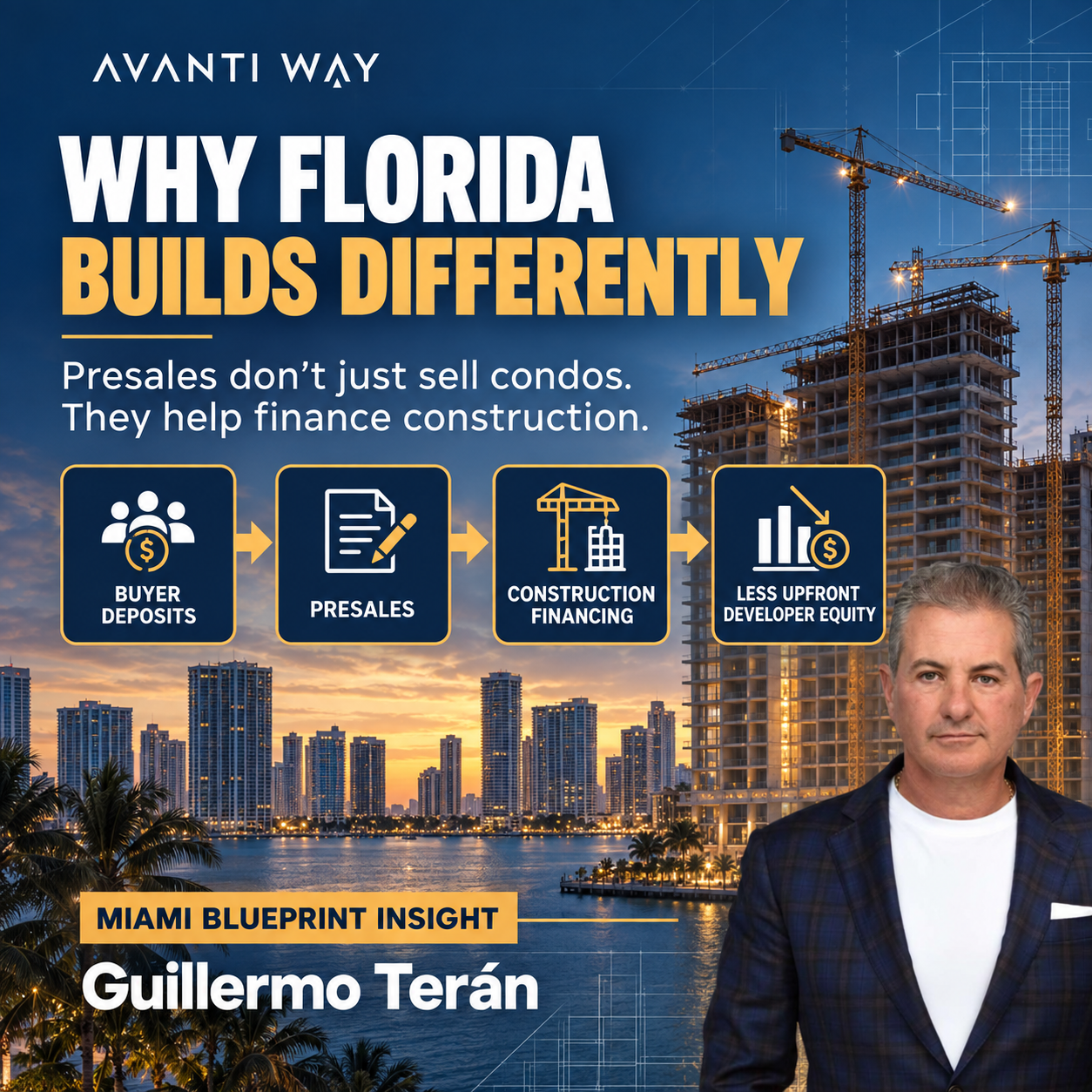
Developers generally use a combination of construction financing, investor or developer equity and buyer deposits to fund a project.
Florida law creates a structured system for handling pre-construction condominium deposits. The initial portion of a buyer’s deposit is generally protected through escrow. Under certain conditions, payments exceeding 10% of the purchase price may be withdrawn and used for actual construction and development costs after construction begins—if the purchase contract specifically permits it and contains the required disclosure.
In other words, not every deposit is automatically available to a developer. The use of those funds depends on the law, the contract, the escrow structure and the project itself. The legal framework is explained in Section 718.202 of the Florida Condominium Act.
When properly structured, however, qualifying buyer deposits can reduce the amount of equity the developer must contribute.
That can significantly improve the developer’s return on invested capital.
A Simplified $100 Million Example
Imagine a new condominium with a total development cost of $100 million.
The capital structure could look like this:
Construction loan: $60 million
Eligible buyer deposits: $25 million
Developer equity: $15 million
Total project funding: $100 million
Now assume the project generates a $30 million profit.
The developer contributed $15 million and receives the original $15 million back, plus the $30 million profit, for a total distribution of $45 million.
That represents:
Equity multiple: 3.0x
Profit-based return on equity: 200%
Now compare that with a project in a jurisdiction or transaction where buyer deposits remain unavailable for construction.
Construction loan: $60 million
Buyer deposits available for construction: $0
Developer equity: $40 million
Total project funding: $100 million
The project generates the same $30 million profit, but the developer had to invest $40 million.
The developer receives the original $40 million plus the $30 million profit, for a total distribution of $70 million.
That represents:
Equity multiple: 1.75x
Profit-based return on equity: 75%
The project cost did not change. The profit did not change. What changed was the amount of the developer’s own capital required to complete the project.
That is the important difference.
Why Capital Efficiency Attracts Developers
Developers do not evaluate projects based only on total profit. They also consider how much of their own capital must be committed, how long that capital will remain tied up and how much risk they must assume.
If a developer can complete a project using less equity, that capital becomes more efficient.
The developer may be able to:
* Reduce the amount of outside equity required.
* Demonstrate buyer demand to construction lenders.
* Improve the project’s potential return on invested capital.
* Preserve capital for additional developments.
* Move viable projects forward more efficiently.
Presales are therefore about more than selling units. They can also help validate demand, strengthen the project’s financing profile and demonstrate that buyers believe in the development before construction is completed.
Capital naturally searches for markets where demand is strong and returns can be attractive. Florida offers both.
Florida Does Not Eliminate Development Risk
This financing structure does not mean that building a condominium in Florida is easy or without risk.
Developers still face land costs, construction inflation, insurance, interest rates, permitting, presale requirements, labor availability, construction delays and market competition. A project must still obtain financing, reach the lender’s required thresholds and generate enough sales to remain viable.
Buyer deposits are one component of the capital structure—not free money and not a guarantee that a project will succeed.
The numbers above are a simplified illustration. Every project has its own financing arrangements, escrow requirements, contracts and risk profile.
What This Means for Buyers
A development that is financially attractive to the developer is not automatically a strong investment for the buyer.
That distinction is extremely important.
The developer is evaluating the return on the capital required to build the project. The buyer must evaluate a different set of questions:
* Is the purchase price supported by the location and comparable properties?
* How much competing inventory will be delivered at the same time?
* Is the developer experienced and adequately capitalized?
* What protections apply to the buyer’s deposits?
* What does the purchase agreement permit the developer to do with those deposits?
* Are the projected association fees and carrying costs realistic?
* Is the property designed for residential living, short-term rentals or another strategy?
* What is the buyer’s exit plan at delivery?
Understanding how a project is financed helps buyers and agents ask better questions. It also helps explain why developers emphasize early reservations, contract conversions and presale momentum.
The Bigger Picture: Why Miami Will Continue to Change
Miami’s transformation is being driven by several forces working together:
1. Continued population and capital migration into Florida.
2. Limited land in South Florida’s most desirable locations.
3. Demand for newer, safer and more efficient buildings.
4. Inspection, reserve and repair obligations affecting aging condominiums.
5. A pre-construction financing structure that can make development capital more efficient.
Demand creates the opportunity. Florida’s development structure can help make the opportunity financially possible.
That combination helps explain why national and international developers continue to enter the South Florida market, why established developers continue launching new projects and why Miami’s skyline is changing so quickly.
Miami Blueprint Takeaway
Florida builds differently because many condominium projects are financed differently.
Our population growth, tax environment, lifestyle and limited prime land attract demand. Our pre-construction structure may also allow qualifying buyer deposits to become part of the development capital stack, reducing the developer’s equity requirement and making capital more efficient.
That does not make development risk-free, and it does not make every new condominium a good investment. It simply helps us understand why developers and capital continue to be attracted to Florida.
The more buyers understand the developer’s side of the transaction, the better prepared they will be to evaluate whether the opportunity also works for them.
Know the Blueprint Before You Buy.
Guillermo Terán
Broker Associate, Avanti Way Realty
Author of Miami’s Pre-Construction Blueprint
Founder of the Avanti Way Pre-Construction Community
This article is for educational purposes only and is not legal, tax or financial advice. Buyers should review the purchase agreement and deposit provisions with a qualified Florida real estate attorney.